


The Complete Sports Wind-Ups of
In the early 1980s, the giant Japanese toy company TOMY produced portable game boards with movable characters that required no batteries. Instead, TOMY designed adorable clackity sports mascot figures who made their way through football gridirons, bowling alleys, basketball courts, and more. In fact, TOMY produced 6 of these sports sets for Western audiences. They even produced a 7th set exclusively for the Japanese market. Here you will find all 7 sets, background, original box art, complete instructions, and exclusive footage from my complete collection. As I learn more about them, I will add it to this site. If you can contribute new information, do not hesitate to reach out, and I will do my best to keep that knowledge alive. Enjoy!


SEE THE COMPLETE VIDEO!

In 1980 TOMY released 4 lunchbox style sports themed table top games: Football, Boxing, Golf and Bowling. They had whimsical names like "Strolling Bowling" and "Goof Around Golf." This was certainly due in part to the unpredictable nature of the wind up characters contained in the depths of the lunchbox.


not yet, baseball!



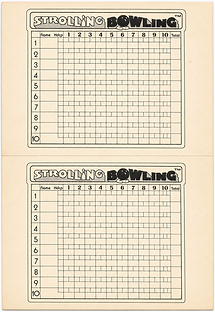
Released by Tomy around 1980 for the American market, Strolling Bowling was one of the standout entries in Tomy’s portable Sports Set line. The game folded open like a plastic lunchbox into a miniature bowling alley, where a tiny wind up bowler “strolled” unpredictably down the lane before crashing into flat spring loaded pins that could all reset at once with a single latch. That reset system was one of the toy’s smartest ideas because it kept the action moving instead of forcing kids to stand every pin up by hand after each frame.time.

Part of what made Strolling Bowling memorable was that it sat somewhere between a toy and a real game. You could actually play ten frames with strikes, spares, and gutter balls, but the wobbling little bowler always introduced chaos and comedy. Tomy leaned hard into that personality in American TV commercials from 1981, which showed the bowler shambling down the lane like a mechanical drunk before unexpectedly knocking down pins. Even today the toy still feels surprisingly alive because every figure develops its own quirks over time.

1980's Ad for Strolling Bowling



Funny Football 1980
This was the first Tomy wind up sports set I encountered. Back when I was a little kiddo in my single digits I was at my friend Dereks house. He has a much older brother who just left for college and we decided to raid his long forgotten toy closet. Among the other treasures was this game which was certainly older than us. We didn't have the rules but figured out a way to play it that kept us competing for hours. For many decades I had thought this play set was a one off. When I went looking on for my own kids I was surprised to find out that this was one of a half dozen sports wind ups. Thus my quest to get all began to unfold of the subsequent years.
Unlike many tabletop sports toys of the era that relied on flicking pieces or static controls, Funny Football felt almost alive because the players constantly veered, collided, stalled out, or accidentally pulled off perfect plays. A touchdown could come from strategy, luck, or complete mechanical nonsense. The figures themselves were surprisingly expressive for such a small toy, with molded helmets, printed numbers, and brightly colored uniforms that gave the teams real personality. In the transcript, the game is described as “basically just a grudge match to kick the football,” which is probably the most accurate way to explain why it remains so memorable.


Unlike many tabletop sports toys of the era that relied on flicking pieces or static controls, Funny Football felt almost alive because the players constantly veered, collided, stalled out, or accidentally pulled off perfect plays. A touchdown could come from strategy, luck, or complete mechanical nonsense. The figures themselves were surprisingly expressive for such a small toy, with molded helmets, printed numbers, and brightly colored uniforms that gave the teams real personality. In the transcript, the game is described as “basically just a grudge match to kick the football,” which is probably the most accurate way to explain why it remains so memorable.


Bumbling Boxing 1980
Much like Funny Football, Bumbling Boxing was Tomy’s wonderfully self aware attempt at turning two unstable wind up toys into colliding athletes. The game unfolded into a tiny ring where two mechanical fighters shuffled toward each other throwing wild swinging punches until one collapsed or staggered backward. The gameplay was simple, get your boxer to knock your opponents off the board. The boxers flailed, locked together, missed obvious hits, or suddenly landed a perfect knockout in a way that felt more like a bar fight than a sporting event. What made the set stand out were the figures themselves. Both fighters had bruised black eyes sculpted directly into their faces, exaggerated gloves, and adjustable arms that could be posed higher for defense or lower for offense before each round.

The toy clearly borrowed from the huge popularity of boxing during the Rocky era, even decorating the cardboard crowd art like a packed fight night arena. Tomy’s advertising leaned into the humor rather than realism, treating the game almost like a slapstick mechanical comedy where half the fun came from watching the fighters stumble into disaster. Tomy must have known that these things were going to flop around and fall off a lot, and instead of hiding that limitation, they built the entire identity of the toy around it.


Goof-Around Golf 1980
Released by Tomy in 1980, Goof Around Golf was one of the more cleverly designed games in Tomy’s Sports Set line because it transformed a tiny wind up figure into a modular miniature golf course... with 18 unique holes!
Instead of using a fixed board, the game came with interchangeable fairway pieces that could snap together into different hole layouts with varying pars, hazards, and angles. The tiny golfer pushed a small branded golf ball while wobbling unpredictably across bumps, sand traps, water hazards, and narrow turns, creating a strange mix of planning and mechanical chaos.
One of the game’s smartest mechanics was that over winding the golfer could actually send the ball flying off course, forcing players to balance power and control much like a real putt. The original instructions even encouraged players to respect out of bounds sections and route limitations when building custom courses. Tomy gave the set a surprising amount of personality through tiny details, from the little removable flag to the textured course pieces and expressive golfer figure. In the transcript, the creator points out how satisfying it is to finally sink the ball after carefully navigating the hazards, especially because the golfer’s unpredictable movement means even a simple shot can suddenly go wrong.


2 New Sports Play Sets
I haven't been able to find any numbers on units sold or how many runs the Tomy wind up sports sets had, but Tomy felt strongly enough about the first four sets from generation I that they produced two new sets in 1981.
Tomy's gameplay ambitions grew and so did the size of the game boards. Portability of the lunchboxes were sacrificed for bigger tabletop experiences. These would be ever so slightly more complex than the gen I toys, yet they were simple enough to learn in just a few play throughs.
Based on my own experience, I would say that these offer the best gameplay of all the sets, especially the Baseball one.
Tomy only made these two sets and then retired the series. Was is it because they weren't a financial success or was it because they ran out of sports? I could have seen a tennis, hockey or even horse racing. While I have no scrapped top secret plans for Tomy, I did find these detailed patents for the Generation II sets, enjoy!


Compared to the earlier Tomy Sports Set games, Hop Along Hoopster, while not a portable lunchbox of fun, played like an unpower mini arcade game.

Hop-A-Long-Hoopster 1981
Released by Tomy in 1981, Hop Along Hoopster was part of the second generation of Tomy Sports Set games and showed the company getting far more ambitious with the design. Unlike the earlier lunchbox style releases, this one was a larger standalone tabletop game with a full backboard, mechanical scoreboard, elevated hoop, and a spring loaded launch system that sent the tiny basketball player flying through the air. The whole game revolves around timing. You wind up Hop Along, let him scramble wildly around the court, then hit the shoot button at just the right moment to launch him toward the basket. There was also a second “pass” mechanism that could redirect him toward a much riskier four point shot, serious high-level game design for the a 1981 toy basketball game.
What is so charming and surprising is how violent the shooting launch pads are. The little plastic player gets absolutely launched into the air over and over again, yet somehow our Hop Along still works more than forty years later.


Homerun Homer 1981
Released by Tomy in 1981, Homerun Homer is my favorite of the entire Tomy Sports Set line and the one I would recommend most if someone could only own a single set.
Part of the second generation of the series, it also moved beyond the earlier lunchbox style format into a much larger baseball diamond with a fold up scoreboard, marked base paths, and dedicated zones for singles, triples, home runs, foul balls, strikes, and outs. Unlike the earlier games where you mostly wind up the figures and let them collide, Homerun Homer gives both players constant interaction.
The little Homer figure itself even has a tiny baseball cap with an “H” on it, which says a lot about how much care went into the design.

Out of all the Sports Set releases, this is the one that feels the most satisfying to actually sit down and play for a long time rather than just admire on a shelf.


This is a true 2 player interactive game. One player winds up the tiny pitcher and sends him toward the plate while the batter spins a rotating turntable beneath home plate to control the direction of the hit. You can actually get good at it. There is timing involved, strategy involved, and just enough unpredictability from the wind up mechanics to make every hit exciting.


Party Mate Sumo 1980
Released by Tomy in 1980 (wrongly called Silly Sumo) was the Japanese exclusive entry in the Tomy Sports Set line, "Party Mate Sumo" and by far the hardest one for me to research.
Most of the information online is incomplete, mistranslated, or missing entirely, so I ended up digging through old Japanese instruction scans, packaging, scorecards, and auction listings just to understand how the game was originally supposed to work. But I did it... for you. I found a working play set and found the best surviving box art, original instructions and score sheet. It seems like I'm only missing the inside of the instructions. If you have access to that, please share to my contact and I'll do my best to keep it alive here.

Original Party Mate Sumo Box - 1980
Compared to Bumbling Boxing, the smaller ring makes the matches much faster and more violent because the wrestlers almost immediately collide and start driving each other toward the edge. The extra arm articulation also gives the game more strategy than you would expect at first glance.


My Reproduction in English

English Reproduction

Original Instructions

English Reproduction
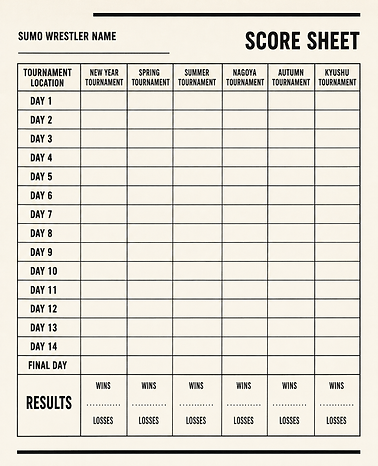
The included score sheet is even modeled after real sumo tournament tracking, with spaces for results from Nagoya, and Kyushu tournaments.

The original instructions are actually pretty through. You don't just wind up and let them go. Before each round, players secretly position the wrestlers’ arms because the arm placement affects the outcome of the fight. The wrestlers are then lined up carefully along the center line of the dohyo and released together on the traditional “Hakkeyoi, Nokotta!” sumo start.
In Conclusion...
The Tomy Sports Set line from 1980 and 1981 is such a great example of taking these little clattering wind up toys and putting them into sports situations that somehow actually work as games. The first generation had the lunchbox style clamshell sets like Funny Football, Bumbling Boxing, Goof Around Golf, and Strolling Bowling. You open them up and suddenly there’s a whole little playfield inside. Then the second generation went much bigger with Hop Along Hoopster and Homerun Homer, which feel much more bespoke and built around their specific sports rather than just winding up two figures and letting them have at it. And then there’s the Japanese sumo release, which was the mystery one for me and took a lot of digging through old Japanese instructions and scorecards to fully understand.
What makes all of them work is that they lean into the unpredictability instead of fighting it. These little guys wobble, drift, fall over, miss obvious shots, and occasionally pull off something perfect completely by a sheer stroke of luck. These toys were no accident, Tomy knew exactly what they were making with this series. They’re funny, mechanical, slightly chaotic, and incredibly satisfying to play. Nearly fifty years later they, kind of, sort of, still work, which honestly feels crazy considering how much abuse some of these poor little wind up athletes take.
Thanks for taking the time out to learn about these treasure from the past. See you next time!


